Full lockup
logo.svg: mark and wordmark, horizontal.
Logos, boilerplate and background on what PadhaiLikhai is being built to do. Everything here is free to use in coverage of the project.
padhailikhai-media-kit.zip: logos in SVG and PNG, icon set, social image and this boilerplate as text.
logo.svg: mark and wordmark, horizontal.
logo-mark-mono-dark.svg: for print and one-colour use.
logo-mark-mono-white.svg: for dark backgrounds.
Keep clear space of at least the height of the arch on all sides. Minimum size 24px. Don't stretch it, recolour it outside the palette below, add effects, or place the dark version on a dark background.
Anek Latin for headings, Mukta for body text. Both are open source and available on Google Fonts, and both have Devanagari companions for when the site adds Hindi.
PadhaiLikhai is an education-finance access platform in development, built to help Indian students discover scholarships, grants and education loans, and understand what they qualify for.
PadhaiLikhai is an education-finance access platform being built for Indian students in India and abroad. India moves close to ₹1,00,000 crore a year through scholarships, education loans, CSR programmes and NGO grants, but that funding sits behind dozens of disconnected portals with inconsistent eligibility rules. An estimated 10–15% never reaches anyone. PadhaiLikhai is being built to unify discovery, make eligibility legible before a student invests effort, let documents be reused across applications, and support students through tracking and renewal. It is designed to work alongside government systems such as the National Scholarship Portal, DigiLocker and Jan Samarth rather than replace them.
PadhaiLikhai is an education-finance access platform in development, built for Indian students wherever they study. India disburses an estimated ₹90,000–1,25,000 crore every year in education funding across central and state scholarships, bank and NBFC education loans, CSR programmes, NGO trusts and international scholarships. The problem is not the supply of money. It is that the funding sits across separate systems, each with its own portal, vocabulary and eligibility rules, leaving students to search, interpret and self-assess across all of them.
Primary research conducted for the project surveyed 40 students, professional-degree candidates and parents. Twenty of the thirty-nine who answered had decided against applying for a scholarship or loan because they were unsure whether they qualified; twenty-one rated their confidence in understanding eligibility rules at one or two out of five. Thirty-four said a single trusted place to discover, check, apply and track would be valuable to them. The sample is small and directional, and is presented as such.
PadhaiLikhai is being built around five capabilities: eligibility intelligence that reads scheme rules against a student's profile; a reusable student profile and document vault; unified discovery across public, private and international funding; application tracking; and continuity across renewals and multi-year study. It is positioned as a coordination layer that works alongside India's digital public infrastructure (the National Scholarship Portal, DigiLocker, Direct Benefit Transfer and Jan Samarth) rather than as a lender, agent or replacement for government systems. The platform has not launched.
In development. Not launched. No public signup.
Estimated ₹90,000–1,25,000 crore in annual Indian education financing flow; 18–20 crore learners who may need financial assistance.
40 respondents, online questionnaire, students and education stakeholders. Directional, not nationally representative.
Market figures are compiled from public government and industry sources. Please attribute survey figures as PadhaiLikhai primary research, 2026, n=40.
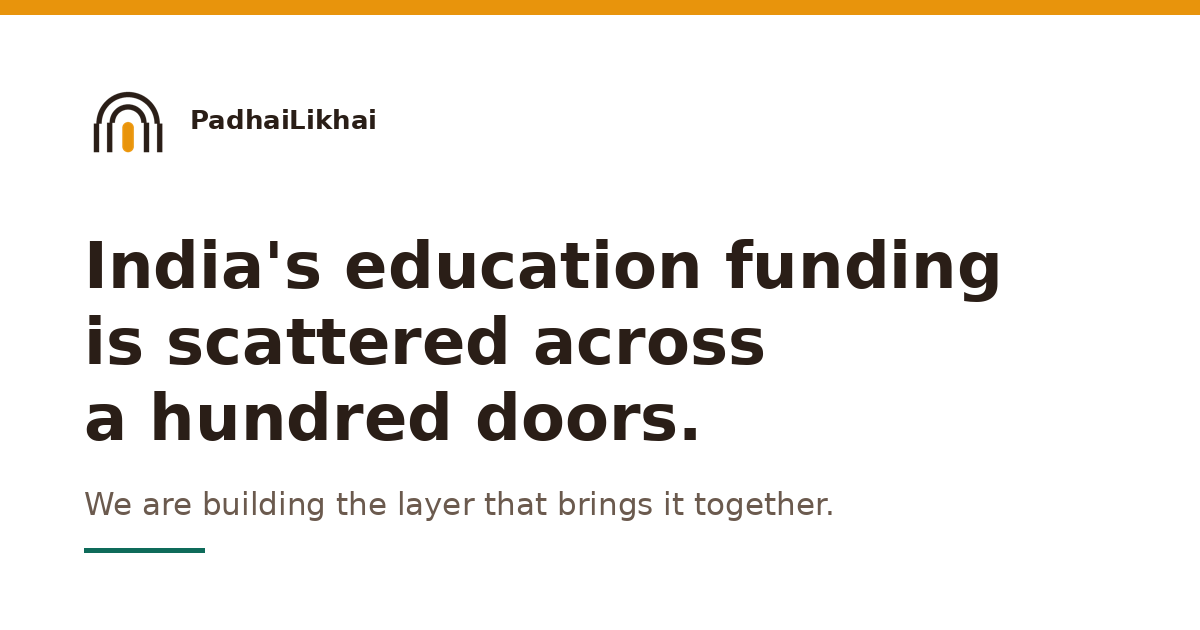
og.png: 1200×630, for link previews and article headers.